What Is an ESC? The Electronic Brain Behind Every Drone Motor
An ESC, or Electronic Speed Controller, is the component that sits between a drone’s flight controller and its BLDC motors.
Its job is to take a low-power signal from the flight controller and convert it into precisely timed, high-power pulses of current that spin the motor at the exact speed commanded.

Without an ESC, a flight controller cannot drive a BLDC motor. The flight controller does not have the power capacity or the switching logic to do so directly.
The ESC handles both of those responsibilities: it manages the high-current power delivery, and it executes the commutation sequence that keeps a brushless motor spinning in a controlled and continuous manner.
Every motor on a drone has its own dedicated ESC. A standard quadcopter has four motors, which means it runs four ESCs. In some compact builds, all four ESCs are combined onto a single circuit board, called a 4-in-1 ESC, but the underlying function remains identical.
How Does an ESC Work?
A BLDC motor has no brushes, which means there is no mechanical mechanism to switch current between its coils.
The ESC replaces that function electronically. It reads the motor’s position using back-EMF (back electromotive force) sensing or, in more advanced designs, dedicated sensor inputs, and then switches current through the motor’s three phase wires in the correct sequence to keep the rotor spinning.

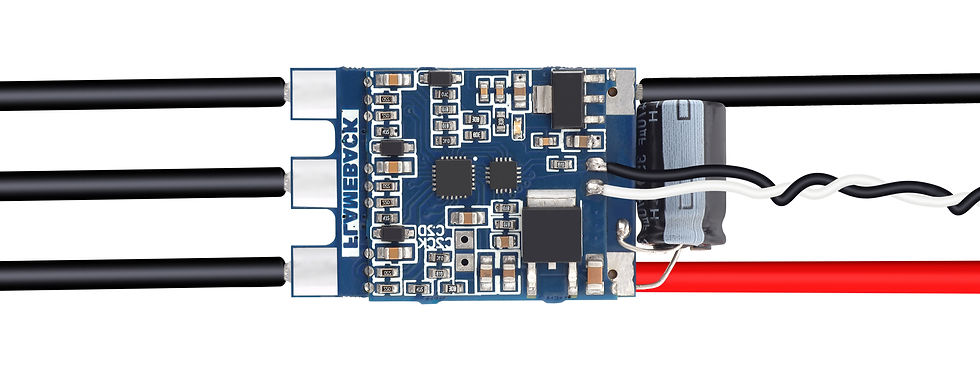
This switching happens using components called MOSFETs (Metal-Oxide-Semiconductor Field-Effect Transistors). These are solid-state switches that can open and close millions of times per second with minimal energy loss. The quality of the MOSFETs inside an ESC directly determines how efficiently it converts battery power into motor rotation.
The process works as follows:
The flight controller sends a throttle signal to the ESC.
The ESC reads the signal and determines the required motor speed.
The ESC switches current through the motor’s three phase wires in rapid sequence.
The motor spins at the commanded speed.
The ESC continuously monitors and adjusts this sequence hundreds of times per second.
ESC vs No ESC: Why You Cannot Skip It
Some builders new to the drone industry assume the flight controller manages motor speed directly. Understanding why that assumption is incorrect helps clarify exactly what the ESC is responsible for.
Function | Flight Controller | ESC |
Reads pilot input | Yes | No |
Calculates required motor speed | Yes | No |
Sends throttle signal | Yes | No |
Drives high-current motor phases | No | Yes |
Executes BLDC commutation | No | Yes |
Handles overcurrent protection | No | Yes |
Manages thermal shutdown | No | Yes |
The flight controller is the decision-maker. The ESC is the executor. Both are required, and neither can perform the other’s function.
Key Specifications You Must Understand
When selecting an ESC for a UAV build, five specifications determine whether the ESC is suitable for the application.
1. Continuous Current Rating (Amperes)
This is the maximum current the ESC can handle on a sustained basis without overheating. It must be equal to or greater than the maximum current draw of the motor it is paired with. Operating an ESC consistently at or above its rated current shortens its lifespan and creates a thermal failure risk.
A commonly followed rule in professional UAV builds is to select an ESC rated at least 20 percent above the motor’s maximum continuous current draw, providing a safety margin for burst conditions.
2. Burst Current Rating (Amperes)
This is the current the ESC can handle for a short period, typically a few seconds, during peak demand such as rapid acceleration or recovery from a wind gust. The burst rating will always be higher than the continuous rating.
Both figures must be checked against the motor’s performance data.
3. Voltage Rating (Cell Count or Voltage Range)
ESCs are rated by the number of LiPo battery cells they support, expressed as a cell count range such as 3S to 6S, or as a voltage range such as 11.1 V to 22.2 V.
Using a battery that exceeds the ESC’s voltage rating will destroy the ESC immediately. The voltage rating of the ESC must match or exceed the battery being used.
4. Supported Protocols
The protocol is the language the ESC uses to receive commands from the flight controller. Different protocols offer different levels of precision and response speed.
PWM: The original analogue protocol. Functional but slower and less precise.
Oneshot125 and Oneshot42: Faster digital variants of PWM with reduced latency.
Multishot: A further refinement offering faster update rates than Oneshot.
DSHOT (150, 300, 600): A fully digital protocol with no signal calibration required, much faster update rates, and built-in error checking. DSHOT600 is currently the industry standard for professional builds.
The ESC and flight controller must support a common protocol for the system to function.
Selecting an ESC that supports DSHOT600 ensures compatibility with all major flight controller firmware used in India today, including ArduPilot and PX4.
5. Environmental Protection Rating (IP Rating)
Drones operate outdoors. An ESC without adequate environmental protection will fail prematurely when exposed to dust, humidity, or rain.
The IP rating indicates the level of protection an ESC provides against solid particles and liquids.
IP56: Protected against dust ingress and water jets from any direction.
IP63: Protected against dust ingress and light rain or water spray.
For agricultural drones, surveillance UAVs, and any application involving outdoor operation in Indian weather conditions, a minimum IP56 rating is advisable.
Understanding Protocols in Depth: Why DSHOT Matters
The shift from analogue protocols like PWM to digital protocols like DSHOT represents one of the most significant practical improvements in drone propulsion control over the past decade.
With PWM, the ESC receives a signal with a pulse width that varies between 1000 and 2000 microseconds. The ESC interprets this as a throttle percentage. This system works, but it is susceptible to electrical noise, requires calibration, and has a relatively slow update rate.
DSHOT sends a 16-bit digital packet to the ESC that includes the throttle value, a telemetry request bit, and a 4-bit checksum. Because it is digital, it cannot be corrupted by electrical interference. Because it includes a checksum, the ESC can detect and discard corrupted packets rather than acting on bad data.
For professional UAV applications where precision throttle control directly affects flight stability, payload safety, and mission success, DSHOT is not a preference. It is the correct choice.
Why Capacitors and PCB Quality Matter
Two internal components that are rarely discussed in basic ESC guides have a significant impact on real-world reliability: the capacitors and the PCB itself.
Capacitors smooth out voltage spikes that occur every time the MOSFETs switch. Without high-quality capacitors, these spikes travel back along the power lines, introducing electrical noise into the flight controller and potentially damaging other components on the drone.
Low-quality capacitors also degrade faster under heat cycling, which is exactly the operating condition an ESC experiences during flight.
PCB quality determines how well heat is managed across the entire board and how reliably the ESC performs across temperature extremes. In Indian operating conditions, where ambient temperatures can reach 45 degrees Celsius or higher during summer, an ESC built on a high-quality PCB with proper thermal design will outlast a cheaper alternative significantly.
These are the components that separate a professionally built ESC from a commodity product, and they are not visible from a specification sheet alone.
ESCs in Indian UAV Applications
India’s drone ecosystem is maturing, and each application segment places different demands on the ESC.
Agriculture: Agricultural spraying drones operate at high throttle for extended periods. The ESC must handle sustained current draw without thermal shutdown. Reliable overcurrent protection is also critical because motor blockages from debris can spike current dramatically.
Surveillance and Defence: These applications require precise throttle control and stable motor response. Any lag between the flight controller command and the ESC output translates directly into reduced stability and sensor accuracy.
Logistics and Delivery: Delivery drones carry dynamic loads that change mid-flight. The ESC must respond quickly to throttle corrections from the flight controller to maintain level flight and stable attitude during payload operations.
Mapping and Inspection: Long-duration flights at steady throttle put the ESC through extended thermal cycles. Robust thermal management and high-quality capacitors are the determining factors for reliability in this category.
What Flameback Tech Is Building for India
The ESC market in India has long been dominated by imported products, which creates the same supply chain and support challenges that affect imported BLDC motors. Flameback Tech manufactures ESCs in India, designed specifically for the propulsion systems and operating conditions common in Indian UAV applications.

Flameback’s current ESC range covers three configurations addressing the full spectrum of professional UAV builds in India.
Flameback ESC Range at a Glance
Model | Current Rating | Voltage Range | Configuration | Best Application |
FT-ESC-45A6S | 45A cont. / 50A burst | 3S to 6S | 1:1 | Mid-size multirotors, agriculture |
FT-ESC-60A12S | 60A cont. / 80A burst | 6S to 12S | 1:1 | Heavy-lift UAVs, industrial builds |
FT-ESC-55A6S-4x1 | 55A cont. / 65A burst | 3S to 6S | 4-in-1 | Compact racing and inspection builds |
All three models support the full protocol stack including PWM, Oneshot125, Oneshot42, Multishot, DSHOT150, DSHOT300, and DSHOT600. Each ESC ships with programmable parameters covering startup power, temperature protection, motor direction, commutation timing, throttle range, and brake settings.
Testing on every unit includes visual inspection to IPC-A-600 Class 2 standards, electrical flying probe testing, PCB inspection reporting, and RoHS compliance documentation. The 4-in-1 model additionally provides real-time telemetry feedback for current and RPM, which integrates directly with major flight controller firmware.
For drone manufacturers, system integrators, and serious hobbyists building in India, Flameback ESCs are available for retail purchase and direct B2B procurement. Dispatch for ESC orders is typically within 4 to 5 days from Gurugram, Haryana, with delivery within 7 to 8 days.
Conclusion
An ESC is not a secondary component. It is the direct interface between the flight controller’s decisions and the motor’s physical output. Every aspect of how a drone responds to pilot input, corrects for wind, manages payload shifts, and maintains stable flight depends on the ESC executing motor commands accurately and without delay.
Selecting an ESC requires matching four parameters without exception: continuous current, burst current, voltage range, and protocol support. Beyond those parameters, the quality of internal components including the MOSFETs, capacitors, and PCB construction determines how the ESC performs over months and years of operation rather than just the first few flights.
For drone builders in India, the additional factor is sourcing and support. Flameback Tech provides a documented, field-tested ESC range that covers mid-size to heavy-lift UAV builds, manufactured and supported in India, with full technical documentation available for integration into professional drone platforms.
Every motor needs an ESC. Choose yours based on specifications, internal quality, and verified testing, not on price alone.
Frequently Asked Questions
1. Can I use any ESC with any BLDC motor?
No. The ESC must be matched to the motor’s maximum current draw and voltage requirements. A mismatched ESC will overheat, fail prematurely, or shut down mid-flight. Always cross-reference the motor’s maximum current rating with the ESC’s continuous current rating, and verify that the battery voltage falls within the ESC’s rated range.
2. What is the difference between a standard ESC and a 4-in-1 ESC?
A standard ESC controls one motor. A 4-in-1 ESC integrates four individual ESC circuits onto a single board, controlling all four motors of a quadcopter from one component. The 4-in-1 design reduces wiring complexity and saves weight, making it popular in compact builds. The electrical function of each channel is identical to a standalone ESC.
3. Why does protocol choice matter for flight performance?
The protocol determines how fast and accurately the flight controller’s throttle commands reach the motor. Analogue protocols like PWM have higher latency and are susceptible to signal noise. Digital protocols like DSHOT600 are faster, noise-resistant, and include error checking. In practice, DSHOT results in more responsive throttle control and more stable flight, particularly during rapid manoeuvres or wind correction.
4. What does the IP rating on an ESC mean for outdoor drone operations?
The IP rating indicates how well the ESC is protected against dust and water ingress. An ESC rated IP56 is protected against dust and water jets from any direction, making it suitable for outdoor operations in Indian weather conditions including monsoon-season humidity and dusty agricultural environments. Operating a non-rated ESC outdoors significantly increases the risk of failure from moisture and particulate contamination.
5. Where can I buy Flameback ESCs in India?
Flameback ESCs are available through the Flameback Tech website at flamebacktech.com, on major Indian online retail platforms, and through direct B2B inquiry for drone manufacturers and system integrators. The 45A ESC is also available in packs of one, two, or four units. Standard dispatch is within 4 to 5 days from Gurugram, Haryana.