What is a BLDC Motor? The Engine Behind Every Modern Drone
BLDC stands for Brushless Direct Current motor. It is an electric motor that runs on direct current (DC) electricity but, unlike older motor designs, does not use physical brushes to deliver power to the rotating parts.

Instead, a BLDC motor uses an electronic controller called an ESC (Electronic Speed Controller) to manage the flow of current. This eliminates mechanical contact inside the motor entirely, which directly results in higher efficiency, longer lifespan, and more precise speed control.
In the context of drones and UAVs, a BLDC motor is not optional. It is the standard. Every quadcopter, VTOL, fixed-wing UAV, and delivery drone flying in India today uses BLDC motors as its primary propulsion unit.
How Does a BLDC Motor Work?
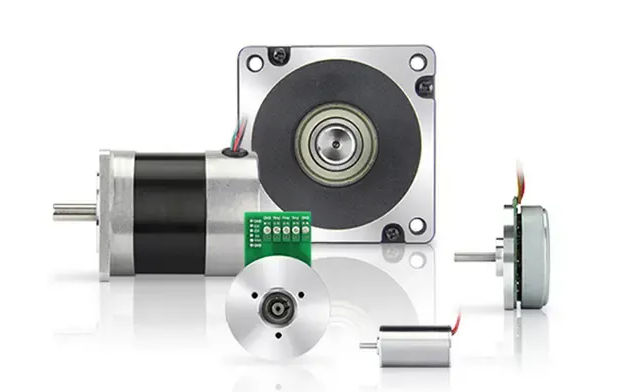
A BLDC motor has two core components:
Stator — the stationary part made up of copper wire windings (coils).
Rotor — the spinning part that holds permanent magnets.
The ESC sends precisely timed pulses of electric current to the stator coils in a specific sequence. Each pulse energises a coil and creates a magnetic field. The rotor’s permanent magnets are attracted and repelled by these fields, causing the rotor to spin continuously.
This process happens thousands of times per minute with no physical contact between the stator and rotor. The result is a motor that generates very little heat, requires no maintenance, and delivers consistent, repeatable performance across its entire operating life.
BLDC vs Brushed Motors: A Direct Comparison
Many people entering the drone industry ask why brushed DC motors cannot simply be used instead. The answer comes down to performance under load.
Parameter | Brushed DC Motor | BLDC Motor |
Efficiency | 75 to 80% | 85 to 95% |
Lifespan | Limited by brush wear | Significantly longer |
Maintenance | Regular brush replacement needed | None required |
Heat generation | Higher | Lower |
Speed control | Basic | Precise and programmable |
Suitability for UAVs | Not viable | Industry standard |
Brushed motors are adequate for low-load, low-speed applications. For any UAV that needs to carry a payload, fly for extended durations, or operate in field conditions, BLDC motors are the only practical choice.
Key Specifications You Must Understand
When selecting a BLDC motor for a UAV, four specifications determine compatibility and performance.
1. KV Rating (RPM per Volt)
KV is the number of revolutions per minute (RPM) the motor completes for every volt applied to it.
High KV (1000 to 1200+): Spins fast. Suited for small, lightweight drones requiring quick throttle response and agile manoeuvring.
Low KV (100 to 500): Spins slower but generates far more torque. Required for large propellers and heavy-payload UAVs such as agricultural sprayers and logistics drones.
2. Stator Size (e.g., 3120, 4220, 6220)
Motor model names encode the stator dimensions directly. The first two digits represent the stator diameter in millimetres, and the last two digits represent the stator height in millimetres.
A larger stator diameter produces more torque. A taller stator height produces more power. Understanding this allows you to match the motor physically to your airframe before reviewing any other specification.
3. Pole Configuration (e.g., 12N14P, 24N28P)
This describes how many stator slots (N) and rotor magnetic poles (P) the motor has. A higher pole count produces smoother rotation at lower RPMs, which improves efficiency and reduces vibration.
This matters significantly in heavy-lift applications where motor vibration can affect sensors, payloads, and flight stability.
4. Maximum Continuous Power (Watts)
This is the amount of electrical power the motor can handle continuously for a defined period, typically 300 seconds. Exceeding this figure causes the motor to overheat.
Always match the motor’s power rating to your battery output and ESC rating to protect all three components.
Why Thermal Management Is Not Optional
One of the most overlooked aspects of BLDC motor selection is heat management. During sustained flight, particularly under load, the motor coils generate heat. If this heat is not dissipated efficiently, winding insulation degrades and motor life shortens considerably.

High-quality BLDC motors address this in two ways. First, through the physical design of the motor casing, using features such as finned housings that increase surface area for passive cooling. Second, through the quality of internal materials, specifically the grade of lamination steel used in the stator, which affects how much energy is lost as heat at the core.
For Indian operating conditions, where ambient temperatures are high and missions are long, thermal management is a decisive factor when choosing a motor, not a secondary consideration.
BLDC Motors in Indian UAV Applications
India’s drone industry is expanding rapidly across sectors. Each application demands a different class of BLDC motor.
Agriculture: Large spraying drones covering several acres per flight require high-torque, low-KV motors with large propellers. The motor must perform reliably in humid, dusty, and chemically exposed environments.
Surveillance and Defence: Reliability and consistent RPM control are critical. Motors must operate predictably at all throttle inputs and maintain stable flight even at altitude or in crosswind conditions.
Logistics and Delivery: Medium-payload drones operating fixed routes require a balance of endurance and thrust. Efficiency at cruise throttle is a key selection criterion.
Infrastructure and Mapping: Long-duration flights at controlled altitudes need motors that maintain efficiency across a wide throttle range without thermal issues developing mid-mission.
What Flameback Tech Is Building for India
India’s drone industry has historically been dependent on imported motor components. This creates supply chain risk, limits customisation, and increases costs for Indian drone manufacturers.

Flameback Tech is an Indian UAV component manufacturer based in Baddi, Himachal Pradesh. The company designs and manufactures BLDC motors, ESCs, and propulsion systems specifically engineered for professional UAV applications.
The Flameback motor range currently covers thrust classes from 2 kg to over 18 kg, addressing the full range of Indian drone applications from compact multirotors to heavy-lift industrial UAVs.
Flameback BLDC Motor Range at a Glance
Motor | Model ID | KV | Max Thrust (100%) | Recommended Prop | Voltage | Max Power |
1606 | FT-BLDC-1606 | 3800 | 287.5 g | Gemfan D63 Ducted 3-Blade | 3S | 150 W |
1608 | FT-BLDC-1608 | 3800 | 317 g | Gemfan D63 Ducted 3-Blade | 3S | 180 W |
1806 | FT-BLDC-1806 | 3000 | 599 g | HQ Ethix P4 Candy Cane 5.1×4×3 3B | 3S | 250 W |
2206 | FT-BLDC-2206 | 1600 | 554 g | HQProp 7×4×3 3-Blade | 3S | 200 W |
2408 | FT-BLDC-2408 | 2300 | 1,234 g | Tri-Blade 5043 | 4S | 550 W |
2808 | FT-BLDC-2808 | 950 | 1,818 g | Tri-Blade 7035 | 6S | 600 W |
2808 | FT-BLDC-2808 | 1350 | 2,391 g | Tri-Blade 7035 | 6S | 1200 W |
3106 | FT-BLDC-3106 | 500 | 1,400 g | Pro-Range 1038 | 6S | 350 W |
Every Flameback motor is backed by a 12-month warranty covering manufacturing defects and is tested to IPC-A-600 Class 2 standards before dispatch. Products carry ISO 9001 certification and are available for retail purchase or direct B2B procurement.
For drone manufacturers, assemblers, and system integrators building in India, Flameback provides a documented, field-tested alternative to imported motors across every major thrust class.
Conclusion
A BLDC motor is the foundation of every capable UAV. Its brushless design eliminates mechanical wear, its efficiency allows longer flight times, and its precise electronic control enables stable, reliable operation across demanding conditions.
Understanding the core specifications including KV rating, stator size, pole configuration, and power rating gives you the ability to select the right motor for any drone application rather than guessing from a product listing.
For drone builders in India, the additional consideration is sourcing. Importing motor components adds lead times, foreign currency risk, and limited technical support.
Flameback Tech addresses this directly with a full range of professionally manufactured BLDC motors designed and produced in India, tested to international standards, and available with local support.
If you are building a UAV platform, evaluating your current motor selection, or scaling a drone manufacturing operation in India, the starting point is always the motor. Choose it based on data, not availability.
Frequently Asked Questions
1. What is the difference between KV 150 and KV 1200 in drone motors?
KV 150 means the motor completes 150 RPM per volt applied. KV 1200 means 1200 RPM per volt. Low KV motors spin large propellers slowly with high torque, suited for heavy-lift UAVs. High KV motors spin small propellers fast, suited for agile, lightweight drones.
2. Can I use any ESC with a BLDC motor?
No. The ESC must be matched to the motor’s current rating and voltage requirements. Using an undersized ESC causes overheating and failure. Flameback recommends specific ESC pairings for each motor model in its product documentation.
3. How long does a BLDC motor last?
A well-matched and properly operated BLDC motor can last thousands of flight hours. The limiting factor is usually the ball bearings rather than the windings. High-quality bearings, such as the German bearings used in Flameback’s 4220 and 6220 motors, extend service life considerably.
4. Why do BLDC motors have different stator sizes?
The stator size determines how much copper wire fits inside the motor, which directly affects how much power and torque the motor can produce. Larger stators are physically bigger and heavier but generate more thrust. The right stator size depends on your target takeoff weight and propeller size.
5. Where can I buy Flameback BLDC motors in India?
Flameback motors are available through the Flameback Tech website at flamebacktech.com, on major Indian online retail platforms, and via direct B2B inquiry for drone manufacturers and system integrators. Dispatch is typically within 7 to 8 days from Gurugram, Haryana.